Why AI decision support in ophthalmology is approved but rarely used: An interview study
By Anne-Kathrin Kleine in artificial intelligence clinical decision support implementation qualitative research
October 22, 2025
AI could ease the growing workload in ophthalmology, and several AI-enabled clinical decision support systems (AI-CDSS) have already received regulatory approval. Yet they are rarely used in practice. In this preregistered study led by Insa Schaffernak, we asked what it takes for ophthalmology professionals to adopt these tools and to keep using them.
What we did
We conducted semi-structured interviews with 22 ophthalmology professionals from Germany, Austria, and Switzerland – residents, attending physicians, heads of department, assistants, optometrists, and study nurses – with very different levels of experience with AI. We analyzed the interviews with a qualitative content analysis guided by the NASSS framework (Nonadoption, Abandonment, Scale-up, Spread, and Sustainability).
What we found
- Most participants were open to AI, especially as a complement to their own expertise – as a second opinion for complex cases, or as support for easy but repetitive assessments where fatigue can lead to oversights.
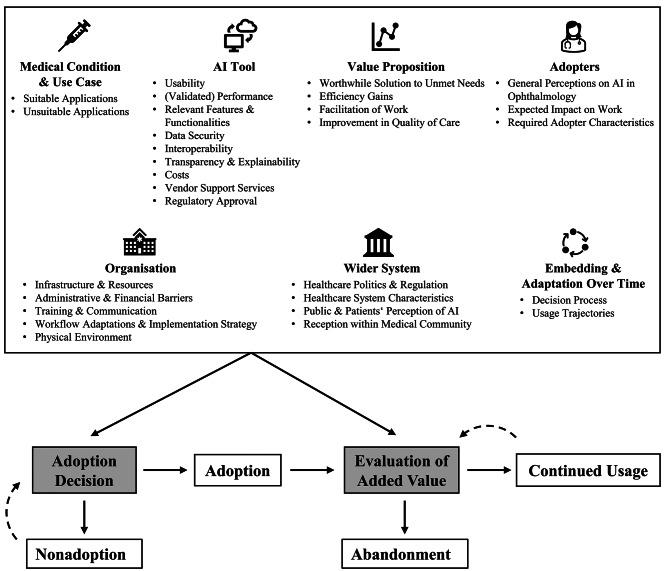
- Whether AI is adopted and adds value depends on 29 sociotechnical factors across all seven NASSS domains, from usability and validated performance to workflows, costs, regulation, and patients’ perceptions.
- Adoption is not a one-time decision: clinicians re-evaluate AI-CDSS repeatedly, weighing expected or experienced value against costs – both before adopting a tool and afterwards, when deciding whether to continue or abandon it.
- Many challenges are shared with traditional health technologies. What sets AI apart is how users psychologically appraise it.
What this means
Regulatory approval is not enough. Developers and implementers need to address users’ needs across the whole sociotechnical system – and support clinicians in evaluating the added value of AI over time. The study also shows that the NASSS framework is a useful lens for studying AI implementation.
Read the paper
Schaffernak, I., Cecil, J., Kleine, A.-K., & Lermer, E. (2025). Sociotechnical influences on the adoption and use of AI-enabled clinical decision support systems in ophthalmology: A theory-based interview study. BMC Health Services Research, 25, 1398. https://doi.org/10.1186/s12913-025-13620-w