Training future psychotherapists with AI-enabled virtual patients: A randomized study
By Anne-Kathrin Kleine in artificial intelligence education psychotherapy training experiments
July 15, 2026
Preparing psychotherapy trainees for the complexity of real clinical encounters is a persistent challenge. AI-enabled virtual patients – simulated patients with whom trainees can conduct conversations and receive automated feedback – promise hands-on practice without risks for real patients. In this preregistered study led by Julia Cecil, we tested whether such simulations improve training outcomes.
What we did
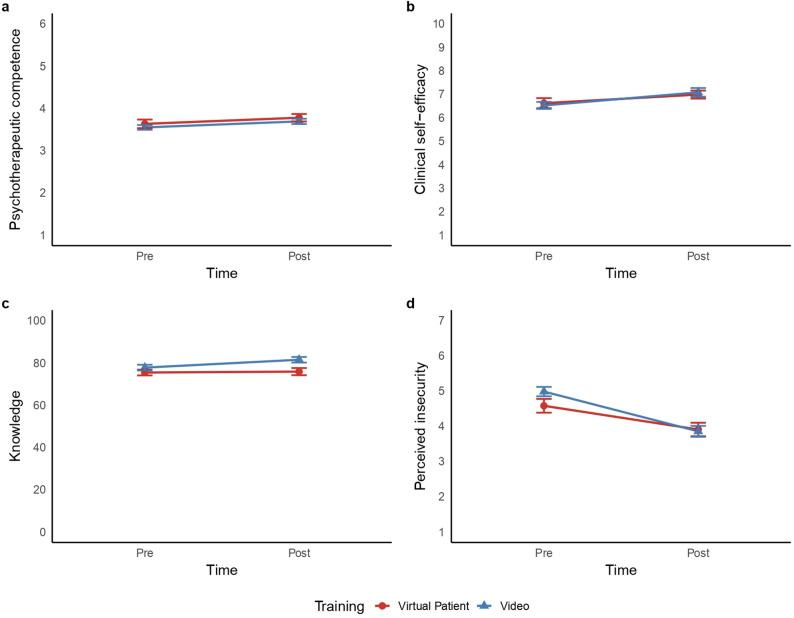
87 psychology students and psychotherapy trainees from Germany and the UK were randomly assigned to either four online sessions with virtual patients (with automated feedback) or four sessions with pre-recorded role-play videos. Each session focused on one disorder – depression, panic disorder, generalized anxiety disorder, or adjustment disorder. Before and after the training, we measured perceived psychotherapeutic competence, clinical self-efficacy, knowledge, and insecurity.
What we found
- Virtual patient training improved perceived competence and self-efficacy and reduced insecurity – but these effects did not exceed those of the video training.
- Neither training increased knowledge about mental disorders.
- More clinical experience was associated with higher competence and lower insecurity, but did not change how much participants gained from the training.
- Insecurity decreased earlier with the video training than with the virtual patients.
What this means
AI-enabled virtual patients are a scalable and engaging complement to psychotherapy training, not (yet) a superior alternative. Good pre-briefings and more authentic virtual patients could increase their benefits.
Read the paper
Cecil, J., Kokje, E., Kleine, A.-K., Schaffernak, I., Vogel, L., Angerer, S., Lermer, E., & Gaube, S. (2026). The effect of AI-enabled virtual patient simulation on training outcomes and insecurities in psychotherapy education. BMC Medical Education, 26, 1156. https://doi.org/10.1186/s12909-026-09917-x