Can the timing of AI advice reduce overreliance? Evidence from face matching
By Anne-Kathrin Kleine in artificial intelligence decision-making overreliance experiments
February 5, 2026
Human–AI teams should ideally perform better than either humans or AI alone. A key obstacle is overreliance: people follow AI advice even when it is wrong. In this project led by Eesha Kokje, we tested whether changing when AI advice is presented can help – using face matching, a task in which people decide whether two photos show the same person.
What we did
In three preregistered online experiments (N = 80, 77, and 86), participants judged pairs of unfamiliar faces with the help of an AI system that was correct in 92.5% of cases. We compared the usual concurrent presentation (advice shown together with the faces) with three non-concurrent alternatives: binary advice on demand, similarity ratings on demand, and conditional advice that was only shown when a participant’s initial decision contradicted the AI.
What we found
- Overall accuracy did not differ between concurrent and non-concurrent advice in any experiment.
- When participants requested binary advice, they followed it more – although they requested it on only about a quarter of the trials.
- When they requested similarity ratings, they followed the advice less: overreliance decreased, but so did reliance on correct advice. Similarity ratings were not more helpful than simple advice.
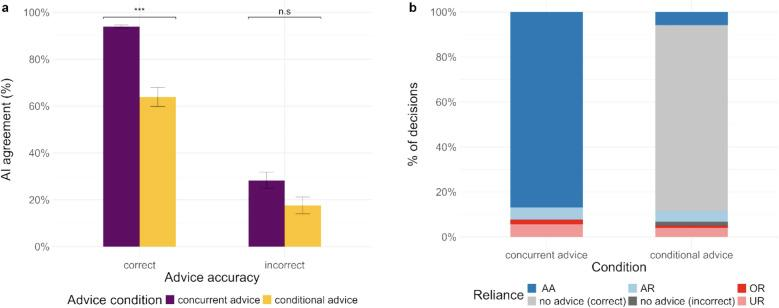
- With conditional advice, participants followed the AI less often. They were more confident when rejecting incorrect advice, but less confident when accepting correct advice.
What this means
Non-concurrent advice can reduce overreliance on AI – but it is no free lunch, because people then also reject more correct advice. The goal should be calibrated reliance, which may require combining presentation formats with information about when the AI is likely to be right.
Read the paper
Kokje, E., Lermer, E., Kleine, A.-K., & Gaube, S. (2026). AI-augmented decision-making in face matching: Comparing concurrent and non-concurrent advice presentation. Cognitive Research: Principles and Implications, 11, 11. https://doi.org/10.1186/s41235-026-00707-z