How many participants do I need? A tutorial on simulation-based sample-size planning for generalized linear mixed models
By Anne-Kathrin Kleine in research methods power analysis open science
December 13, 2024
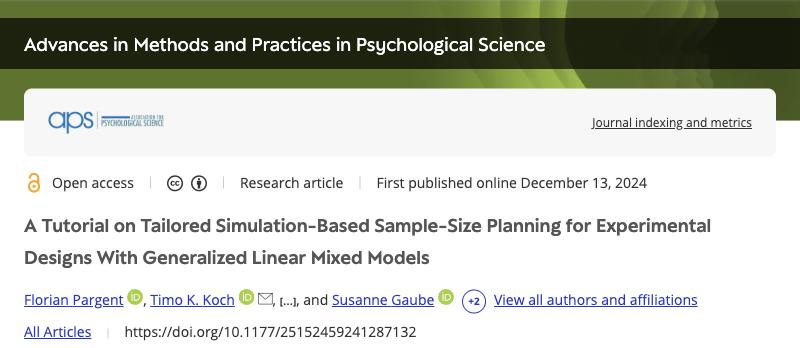
Many experiments in psychology have a nested structure: each participant responds to many items, and both participants and items vary. Generalized linear mixed models (GLMMs) handle such data well – including binary outcomes such as correct versus incorrect decisions. Planning the sample size for these models, however, is difficult: existing software only covers specific designs, and directional hypotheses that combine several comparisons are hardly supported at all.
What we did
Together with Florian Pargent, Timo K. Koch, Eva Lermer, and Susanne Gaube, I co-authored a hands-on tutorial on tailored, simulation-based sample-size planning. The running example is a human–AI interaction experiment: radiologists and medical students diagnose bleedings in head CT scans with or without AI advice, and the advice can be correct or incorrect. The tutorial walks through all steps – defining the estimand, simulating the data-generating process, choosing plausible population parameters, fitting the model, and repeating the simulation many times – and provides R code for each of them.
What it shows
- Simulations make it possible to plan sample sizes for exactly the design and hypotheses at hand, including several directional comparisons that must hold simultaneously.
- Besides classical power analysis, the tutorial shows how to plan for precision, that is, for a desired width of the confidence intervals.
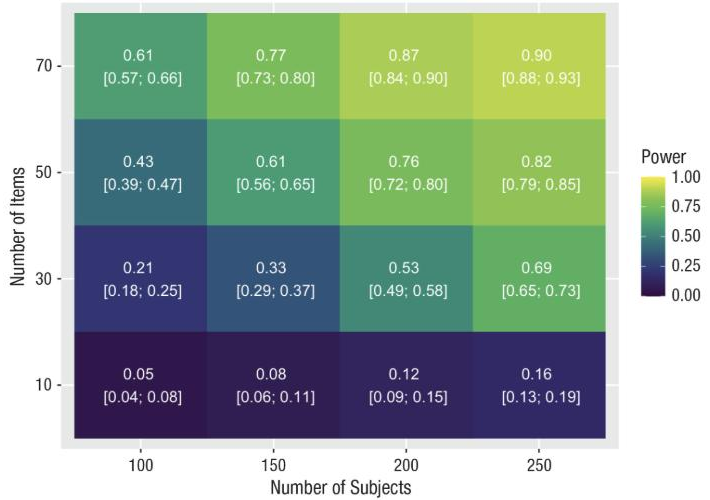
- In the case study, a power of about .80 required, for example, 250 participants who each respond to 50 items, or 200 participants who respond to 70 items – illustrating the trade-off between the number of participants and the number of items.
What this means
Simulation-based planning takes more thought than plugging numbers into a calculator, but it forces researchers to make their assumptions explicit – and it works for the complex designs we actually run. We argue that it should become a standard part of methods training.
Read the paper
Pargent, F., Koch, T. K., Kleine, A.-K., Lermer, E., & Gaube, S. (2024). A tutorial on tailored simulation-based sample-size planning for experimental designs with generalized linear mixed models. Advances in Methods and Practices in Psychological Science, 7(4). https://doi.org/10.1177/25152459241287132
- Posted on:
- December 13, 2024
- Length:
- 2 minute read, 371 words
- Categories:
- research methods power analysis open science
- Tags:
- research